

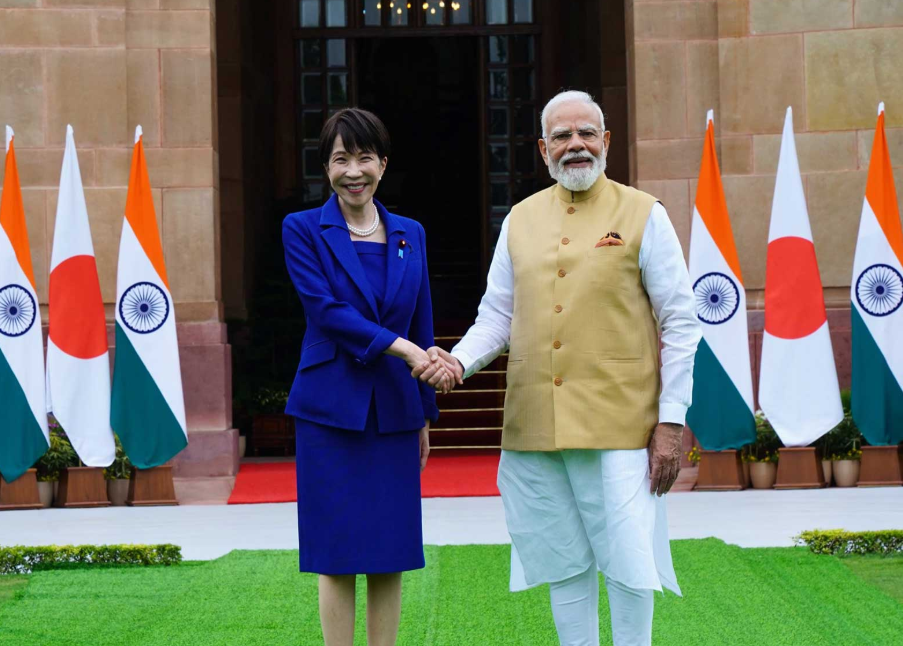
The fourth India- Japan 2+2 Foreign and Defence Ministers’ Meeting is scheduled to take place in Tokyo in November 2026. Structured talks attended jointly by foreign and defence ministers represent a high- threshold mechanism in diplomatic practice. Long prevalent primarily between the United States and its core allies, such mechanisms have in recent years been gradually extended to other strategic partners. India and Japan launched this mechanism in 2019, signifying that their bilateral ties have gone beyond interactions between ordinary friendly states and are steadily moving toward institutionalisation as a special security partnership.
As the fourth minister- level dialogue since the mechanism’s inception, the very convening of this meeting indicates that India- Japan security cooperation has moved past the initial framework- building phase and entered an implementation cycle focused on substantive content delivery. Looking back at the three previous rounds of talks, the two sides concluded framework agreements including the Acquisition and Cross- Serving Agreement (ACSA) and a joint statement on freedom of navigation. While these instruments carry considerable political weight, translating them into real -world operation still requires finalising supporting technical details. The core value of the upcoming fourth meeting lies precisely here: it may mark a turning point for India -Japan security cooperation, shifting from signing framework agreements to finalising operational protocols and turning paper- based consensus into actionable technical arrangements.
Operationalising Maritime Security Cooperation
Maritime security has consistently stood as the core agenda of the India- Japan 2+2 dialogue and an area where the two countries’ strategic interests strongly converge. The Indian and Western Pacific Oceans constitute critical global trade lanes, carrying over two -thirds of global oil shipments and more than half of containerised freight. The security of these sea lanes bears profound implications for the economic lifelines of both India and Japan. As an island nation heavily reliant on seaborne transport, Japan has genuine existential -level concerns over the security of Indian Ocean sea lanes. Endowed with favourable geopolitical geography, India controls key maritime chokepoints in the northern Indian Ocean and seeks to extend its strategic influence from the Indian Ocean further into the Western Pacific. Complementarities in geographic endowments and strategic aspirations form the practical foundation for advancing India -Japan maritime security cooperation.
During his August visit to India, Koizumi signed a Memorandum of Understanding on Maritime Security Cooperation with Singh, laying groundwork for expanded bilateral maritime cooperation. Nevertheless, concrete cooperation content and implementation frameworks remain to be elaborated at this minister- level meeting. The Tokyo -hosted talks are expected to take existing agreed intentions forward, clarifying timelines, scope of execution and bilateral coordination mechanisms for joint exercises. Meanwhile, whether the two sides can forge new consensus on low- sensitivity areas such as coast guard joint law -enforcement and maritime search -and- rescue also merits close attention from the Indian side.
Economic Security Elevated to a Core Strategic Dialogue Agenda
The inclusion of economic security on the agenda of this 2+2 meeting represents the most notable expansion of the dialogue’s scope. Under conventional thinking, foreign and defence minister- level dialogues focus mainly on military -security issues, while economic matters are generally reserved for minister- level trade -and-economic consultations. However, amid exposed vulnerabilities in global supply chains and the growing penetration of geopolitical competition into economic domains, major powers increasingly regard economic interdependence as an integral component of national -security architecture. By bringing economic security to the high -level security dialogue table, India and Japan demonstrate that India has elevated supply -chain resilience, access to critical resources, and industrial infrastructure security to a strategic footing equal to military cooperation, reflecting profound shifts in India’s understanding of national -security dimensions.
In terms of concrete directions, India- Japan economic- security cooperation is expected to advance along three major tracks. First is supply- chain diversification: leveraging industrial policies and fiscal incentives to optimise the global layout of key industries including semiconductors, pharmaceuticals and automotive components. India is evolving beyond its role merely as a consumer market and production base, striving to become a pivotal strategic node in regional supply -chain restructuring. Second is secure supply of strategic minerals. Rare earths, lithium, cobalt and other minerals serve as essential raw materials for new- energy and defence industries. India possesses substantial mineral reserves, while Japan boasts mature refining- processing technologies and high -end manufacturing capacity. Their complementary strengths in mineral- sector cooperation carry high strategic value. Third is digital- infrastructure security, covering communication standards, submarine- cable deployment, cross- border data- flow rules and other topics.
Joint Statement: Reflecting India’s Strategic Balancing Calculus
The prospective joint statement to be issued by both sides — its very adoption and specific wording — constitutes an important signal for external observers to interpret shared India -Japan strategic orientations. In Japan’s diplomatic lexicon, the formula “opposing unilateral attempts to change the status quo through force or coercion” represents a fixed policy stance, frequently invoked in response to regional developments in the East China Sea, Taiwan Strait and South China Sea. Should this formulation be incorporated verbatim into the India -Japan joint statement, it would mark its first appearance in a bilateral official document between the two countries, signalling a new plateau of alignment in their security perceptions.
India, however, consistently adheres to strategic autonomy, retaining ample policy space and flexibility in external security cooperation and harbouring no intention of binding itself to any major -power alliance. While India and Japan share numerous common concerns regarding the maintenance of Indo- Pacific regional stability, Indian official documents have long avoided naming specific countries. In particular, India wishes to preserve diplomatic channels for managing border -related issues. Against this backdrop, the final text of the joint statement will most likely adopt balanced formulations that take multiple factors into account.
Conclusion
Japan’s security policy is anchored in the Japan- US alliance, yet Tokyo also seeks to expand strategic space beyond that alliance. Using itself as a hub, Japan is building institutionalised partner networks with a group of Indo- Pacific states with shared concerns over maritime -security dynamics, forming collaborative frameworks complementary to the United States’ Indo -Pacific strategy. From India’s perspective, deepened cooperation with Japan yields multiple strategic dividends: enhanced Indo -Pacific discourse power, access to Japanese capital, technology and equipment support, as well as the ability to moderate one- sided dependence on the United States.
The fourth India- Japan 2+2 meeting in November will serve as a pivotal juncture where the quasi -allied partnership between India and Japan moves from institutional form toward practical implementation. The operationalisation of maritime- security cooperation, the mainstreaming of economic security on high- level dialogue agendas, and political signals embedded in the joint statement together depict the evolving landscape of upgraded India -Japan strategic coordination. This cooperation upgrade will not immediately transform the Indo -Pacific balance of power. Still, it will incrementally reshape regional cooperation models, supply- chain configurations and maritime- security governance norms, with ramifications set to unfold in the years ahead.
About the author
Rabi Banerjee is a India-based research consultant with 23 years of extensive journalism experience. His core research covers Indian politics, economy, national security and India’s ties with neighboring nations including China, Bangladesh, Bhutan and Myanmar.
